


Last summer, while I was in Alaska following a “rogue” geologist for a National Geographic magazine feature, I met a man I knew I had to profile. His name is Phil Gordon.
Phil’s a 77-year-old retired librarian who lives in a dry cabin at the very edge of a 247-foot cliff outside of Homer, Alaska. He’s good friends with the geologist I was following around, Hig. And buried on his property is an experimental extensometer called a Roger Bilham instrument, which measures how quickly Gordon’s bluff is sliding into the sea.
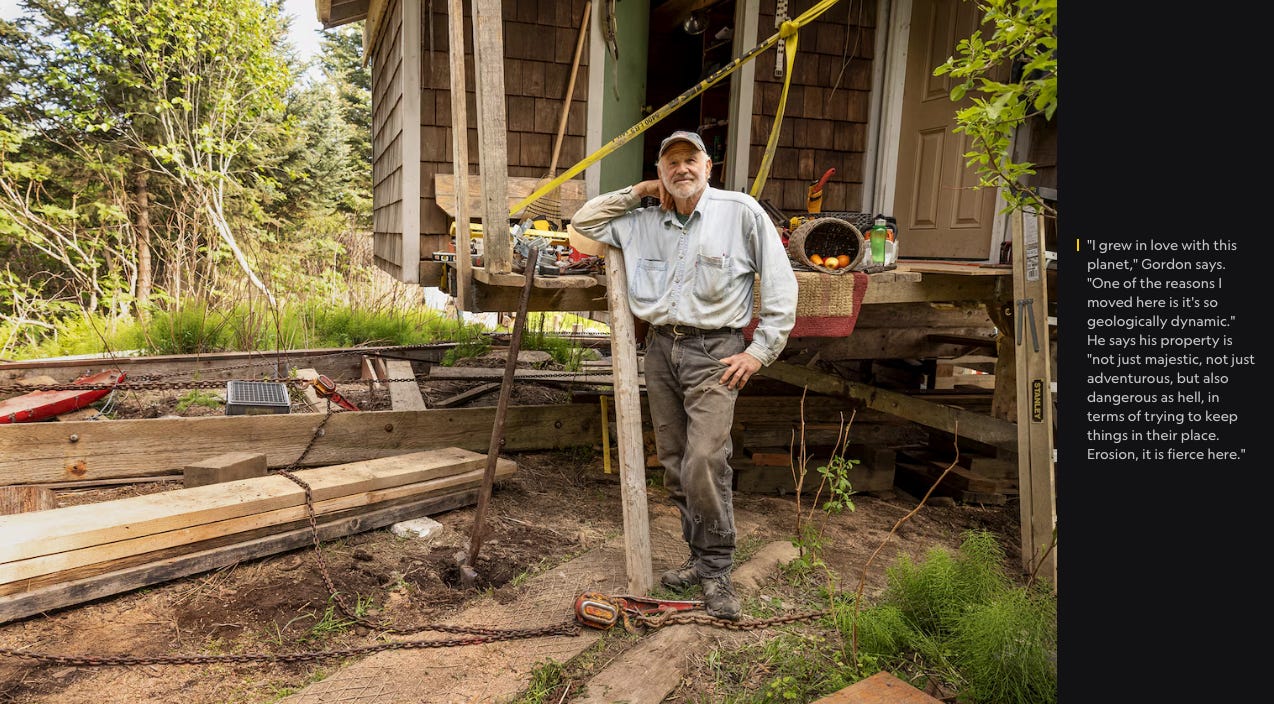
The land under Gordon’s cabin is (very likely) a creeping, bedrock landslide — exactly what Hig specializes in. Around the world, permafrost thaw, increasing (in intensity and frequency) rainfall and glacier retreat is destabilizing solid rock, accelerating it downslope. The Tracy Arm, Blatten and now Nepal/Tibet landslides in the past two years are evidence of that trend. Gordon’s case is a little different — coastal erosion plays as much a role as climate change here — but I was so taken with him as a character, my editor agreed we could do a story, even though it didn’t fit into the main feature.
The piece was published late last month online, along with a short social media video shot by Corey Arnold (the same photographer who accompanied me in Alaska last summer) out last week.
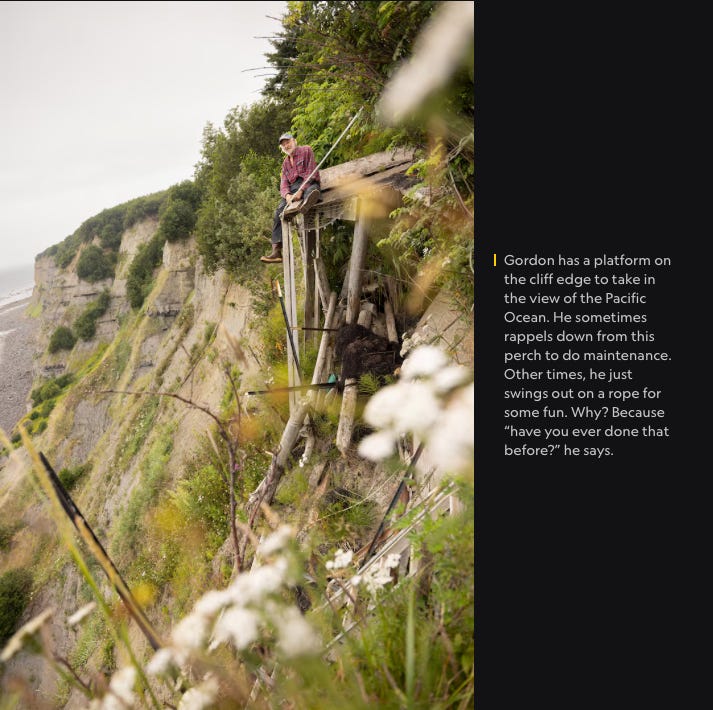
I spent maybe two hours with Gordon in total. In that time, he dropped so many quotable lines I had more material than I knew what to do with. When we drove up (and parked behind his dented white pickup, full of driftwood logs collected on the beach for unspecified reasons), Hig and I found him sitting on a rickety wooden platform dangling over Pacific Ocean. He offered us bourbon and peanut butter. The first thing he said to us became the opening scene of the story: “Help yourself. We’re living abundantly.” He asked if I wanted to swing out over the cliff edge on a rope he’d installed from a beam for that purpose, just because “have you ever done that before?” I told him I’d signed some paperwork with National Geographic’s security team that probably said something about avoiding unnecessary risks.
Gordon knew exactly what he was getting into when he bought this cabin on a crumbling cliff. He calls it a “foolish place to live.” But he was just so taken with the majesty of his kitchen window view — volcanoes, mountain ranges, storms over the ocean. He needed a retirement project, and he decided it would be fighting erosion. He was a boxer for years — he needed an opponent, and the Pacific Ocean seemed a worthy, beautifully futile one. He calls his worldview “joyous fatalism.” He loves the feeling of living on the edge. He’s done some crazy stuff in that long, losing battle — dangling off the cliff to pound in reinforcing beams, renting an excavator to build a seawall of boulders on the beach, burying hundreds of feet of drainage tile to direct water off the edge.
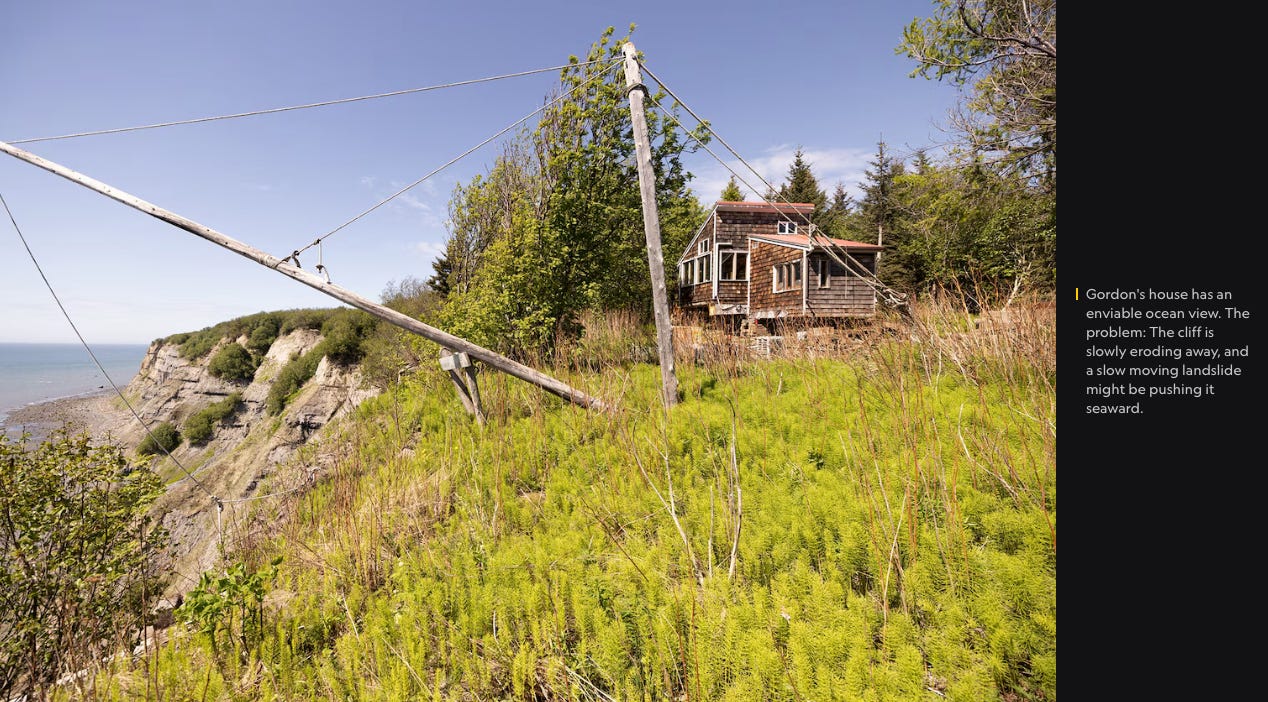
Gordon grew up running from erosion. His father watched his Texas farm blow away in the Dust Bowl — they fled to Oregon. “Ironic, for a guy who hates erosion, to house himself permanently at a site where it is most active,” he told me.
“Well, this way you get to fight back,” I said.
“I try to think of it as loving back,” he said. The engineering solutions helped, but the dozens of trees, currant and raspberry bushes, chives, mint, lupines, peonies Gordon’s planted over the years have had more of an impact — holding the bluff together with their roots. Stacks of plastic starting trays are balanced everywhere around the small garden, on the cabin’s porch — more loving in progress. It’s worked amazingly well. On either side of Gordon’s property, houses have fallen off the cliff over the years, taken by erosion. Other parts of the bluff lose feet of land every year; Gordon’s loses inches.
Then, Gordon met Hig. He learned his bluff might not just be eroding from the ocean side — it might also be slowly sliding toward the sea. His wife Kyra (coincidentally, he says) stopped enjoying spending nights at the cabin, especially on nights with heavy rainstorms. Gordon decided to do something a little crazy — to move his cabin, by hand, 30 feet back from the cliff edge.
Gordon was just getting started last summer when I visited — slowly jacking the cabin up off the ground, supporting it with wooden dunnage blocks. It was perched precariously in the air when he showed me around (and under) it, wading through peony bushes. Why do it by hand? For the challenge, of course. And because heavy machinery might hurt his garden.
Through phone calls over the following months, I tracked Gordon’s progress. It was slow going, with help from artist friends and his daughter’s assistant peony farmer when they could spare the time. This spring, Arnold visited to film Gordon as he dragged the cabin along rails with a hand-crank chain come-along. Now, finally, the move is done. Gordon’s bought himself a little more time in his favorite place. Even though he’s a bit sad to be further from the edge — and his view.
Phil’s story struck me because he’s on the front line of the climate crisis. There’s no government agency or insurance company between him and oblivion. He’s making hard decisions right now that we’ll all have to face eventually. I really enjoyed putting this one together. You never know who you’re going to meet in the field, and where they might lead you!
I immensely appreciate the idea of "loving back" vs "fighting back" and the concept of living abundantly. Glad you have the opportunity to meet increbibly inspiring people like this in your journalistic journey, and take the time to share them with the world.
Two hours and more quotable lines than you could use is a ratio I have never once managed. I have come home from a full day in the field with three usable sentences and extensive notes about the weather, so I recognize the particular panic of the good material arriving faster than you can write it down.
The engineering losing to the peonies is what I did not expect. Beams pounded in while dangling off a rope, a rented excavator, hundreds of feet of drainage tile, and the thing actually holding that bluff together turns out to be currant roots. That is a far better ending than the boxing metaphor sets you up for, and the neighbors losing feet a year while he loses inches makes the point without anyone having to say it.